
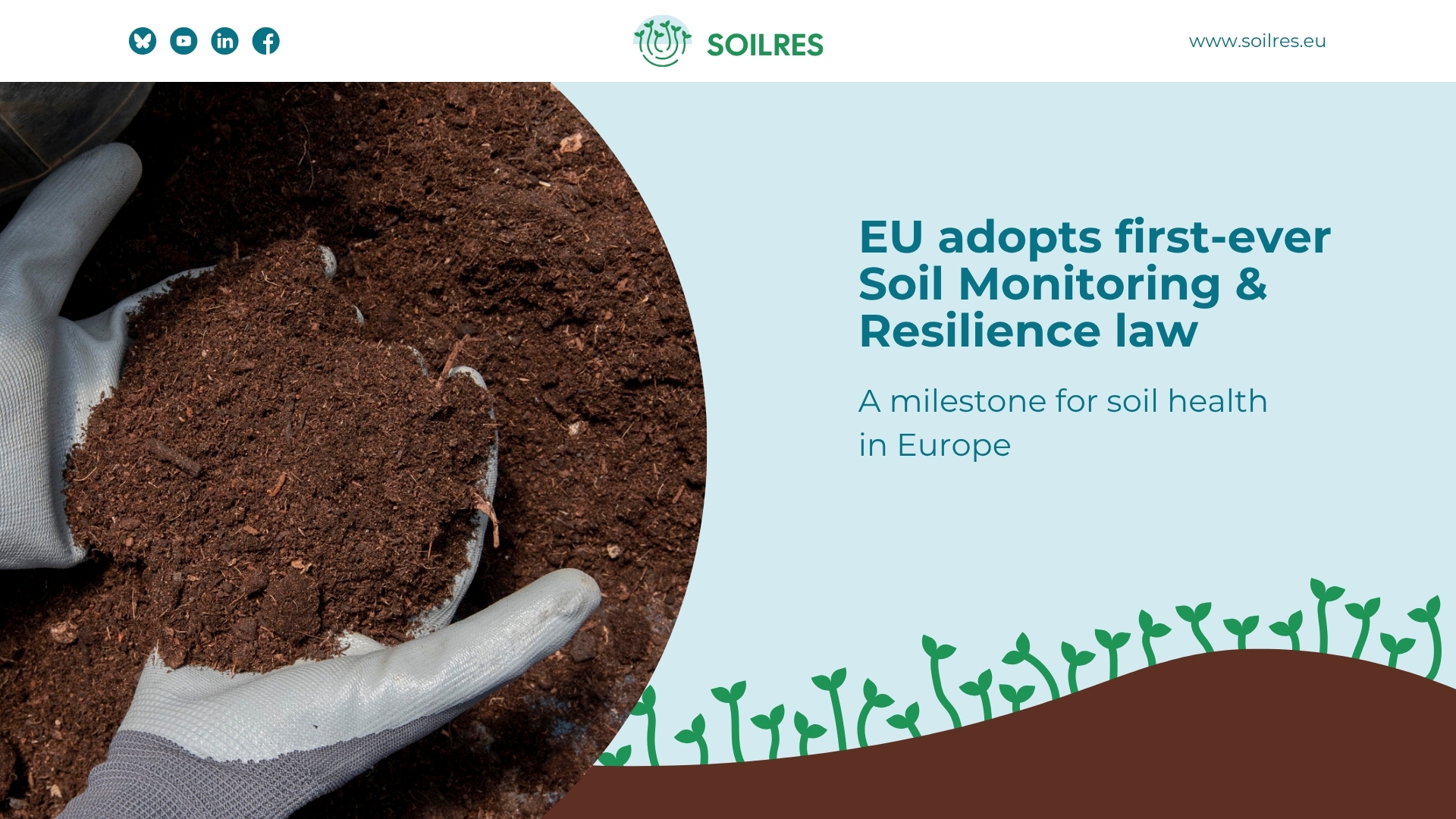
SOILRES is pleased to announce that the EU has taken a decisive step towards protecting and restoring soils across the Union: the legislative package known as the Soil Monitoring and Resilience Directive (the “Soil Monitoring Law”) has reached final political agreement at EU level. The new law creates a common, EU-wide framework for monitoring soil health, tackling soil contamination, tracking land-take (soil sealing and removal) and supporting measures for sustainable soil management — putting the EU on a pathway to healthy soils by 2050.
What the law does — quick summary
- Establishes an EU-wide, harmonised soil monitoring framework so Member States collect comparable information on soil status and trends.
- Requires Member States to implement national monitoring schemes (with Commission support) and to report periodically on progress towards healthy soils.
- Puts the fight against soil contamination and the monitoring of soil sealing/soil removal at the centre of policy, with provisions to identify and address sites where contamination poses unacceptable risks.
- Contributes to EU goals on climate, biodiversity and food security by recognising soil health as essential for ecosystem services and resilience.
Why this matters for farmers, researchers and local authorities
Healthy soils deliver water regulation, nutrient cycling, food production and carbon storage; services that are essential for both people and the climate. The new directive creates the monitoring backbone needed to measure these services consistently across Europe, target remediation and guide investment and agricultural practices where they are most needed. The Commission and Member States will be able to better coordinate actions, from restoring contaminated sites to reducing land take, on the basis of comparable data.
Timeline and next steps
The Council adopted its position and the final compromise texts in the course of 2025; parliamentary steps and formal signature procedures will follow before the directive enters into force. Member States are expected to have a transposition period once the text is published in the Official Journal (the Commission and EU bodies will provide support during the first national monitoring rounds). The directive foresees regular Commission reporting to the European Parliament and Council on implementation and progress towards the 2050 objective.
SOILRES take
This law provides a long-needed, EU-level framework that can finally turn fragmented national efforts into an integrated monitoring system — the foundation for targeted restoration, evidence-based policy and better support to land managers. For researchers and innovators, it opens opportunities for harmonised data, cross-border studies and new services; for practitioners it means clearer standards and, importantly, EU support mechanisms during the rollout.
Learn more from official EU sources:
- Proposal for a DIRECTIVE of the European Parliament and of the Council on Soil Monitoring and Resilience (Soil Monitoring Law) — EUR-Lex (proposal text / legal dossier). EUR-Lex
- Council press release: “Soil monitoring law: EU on the pathway to healthy soils by 2050” (Council / Consilium). Consilium
- Council / Coreper and Council documents on adoption / position (Coreper listing and Council documents, Sept–Oct 2025). Consilium+1
- European Parliament legislative resolution (10 April 2024) on the Soil Monitoring and Resilience proposal — EUR-Lex. EUR-Lex